

A delayed drawing revision can hold up site work, trigger rework, and create avoidable disputes. In large construction, engineering, and infrastructure environments, that is why the question what is enterprise document management system matters far beyond IT. It is a project control question, a compliance question, and often a cost question.
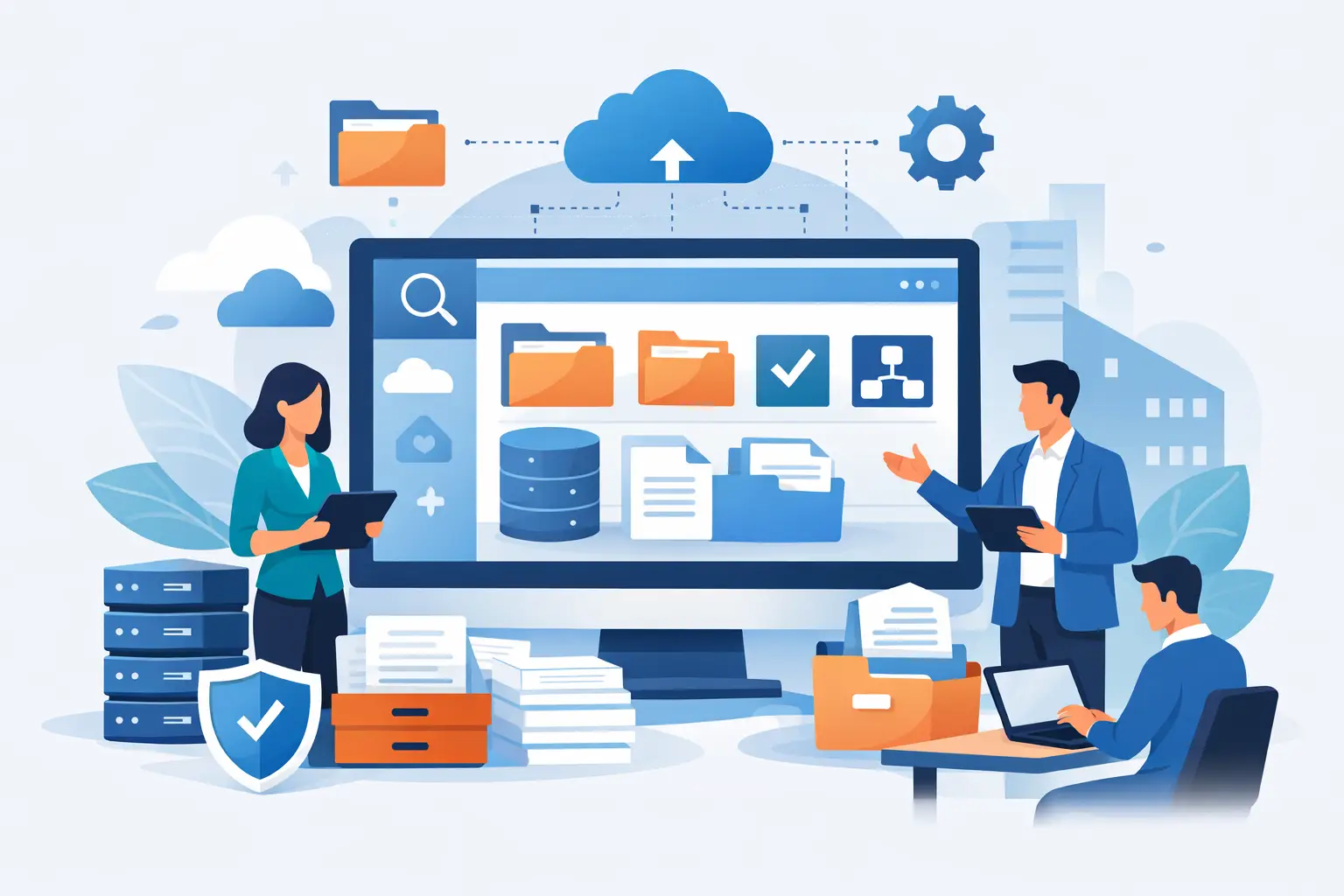
An enterprise document management system, often shortened to EDMS, is a centralized platform used to capture, store, control, track, retrieve, and distribute project and business documents across an organization. In practical terms, it gives teams one governed environment for drawings, method statements, inspection records, RFIs, correspondence, technical submissions, approvals, handover files, and other controlled documents.
The word enterprise is important. A basic file server or shared drive may store documents, but an enterprise document management system is designed for scale, accountability, and controlled workflows. It supports multiple users, multiple departments, defined permissions, version control, audit trails, retention rules, and formal approval processes. In project environments, it also has to work across head office, consultants, contractors, subcontractors, and site teams without losing control of document status.
What is enterprise document management system used for?
At its core, an EDMS exists to make sure the right people can access the right document version at the right time, with a clear record of who issued it, reviewed it, approved it, revised it, or superseded it. That sounds straightforward until a project includes thousands of drawings, test reports, site instructions, material records, and inspection forms moving between teams every day.
In high-accountability environments, document management is not just storage. It is governance. A proper system controls numbering structures, metadata, transmittals, review cycles, status codes, and access rights. It reduces the common risks that come from email attachments, local desktop copies, untracked edits, and paper files that cannot be checked quickly when a claim, audit, or defect investigation appears.
For construction and public works delivery, the system is often used to manage technical submissions, drawing workflows, supervision records, quality documentation, and as-built documentation. When tied to inspection and records processes, it becomes part of the operational backbone of project delivery rather than an isolated admin tool.
How an enterprise document management system works
An EDMS works by placing documents inside a controlled structure instead of leaving them scattered across folders, inboxes, and physical binders. Each document is registered with identifying information such as project code, discipline, document type, revision, status, originator, and date. That metadata allows the document to be searched, filtered, reported on, and routed through workflows.
Version control is one of the most important functions. When a drawing is revised, the system records the new version while preserving the previous one. Teams can see which copy is current, which has been superseded, and when the change happened. This reduces the risk of site teams working from outdated information.
Workflow control is equally important. Documents can be routed for review, comment, approval, or distribution according to predefined business rules. A design submission may go from consultant to project manager to client reviewer. An inspection report may move from site supervision staff to quality management and then into final records. The system captures each action and timestamp, creating an audit trail that can be relied on later.
Access control adds another layer. Not every user should have the same rights. Some should read only, some should upload, and some should approve or issue documents externally. In enterprise environments, this matters not only for security but also for contract governance and regulatory compliance.
Why shared drives are not enough
Many organizations start with folders on a server or a cloud storage platform. That can work for small teams or low-risk internal administration. It becomes unreliable when the project environment is large, contractual, and document-heavy.
Shared drives generally do not enforce formal workflows. They do not reliably control revision status, and they depend too much on user discipline for naming, filing, and distribution. Search is often weak, reporting is limited, and proving who approved what can become difficult. When disputes arise, poor document control turns into a management problem very quickly.
An enterprise document management system addresses those gaps with process discipline built into the platform. That does not mean every organization needs the same level of complexity. It does mean that if document failure can delay work, create non-compliance, or weaken defensible records, then basic storage tools are usually not enough.
The business value in project environments
For project owners, contractors, consultants, and engineering firms, the value of an EDMS is not theoretical. It appears in daily execution. Teams spend less time chasing files, checking whether a revision is current, or asking who approved a submission. Approvals can move faster because routing is structured. Field records become easier to retrieve during progress reviews, audits, and handover.
There is also a quality benefit. When inspection records, supervision forms, and supporting documents are managed under one controlled environment, the project record becomes more complete and more defensible. That matters for compliance inspections, payment support, final account discussions, and long-term asset documentation.
For organizations operating under public works requirements or internal governance standards, auditability is often a deciding factor. A proper EDMS provides traceability. If a reviewer asks when a drawing was issued for construction, who reviewed a material submission, or whether a corrective action was closed, the answer should be available inside the system rather than pieced together from emails.
What features matter most
Not every feature has equal value. For complex project delivery, the most important capabilities are usually document registration, metadata control, revision and version management, workflow automation, permissions, search, audit history, transmittal management, and reporting.
Integration can matter just as much as core features. If a system can connect with BIM-related workflows, digital inspection platforms, records management processes, and scanning operations, it becomes easier to maintain one reliable information environment. That is especially relevant on large infrastructure contracts where office and site activities cannot be treated as separate digital islands.
Usability should not be overlooked. A system may be technically capable but fail in practice if site teams avoid it, if submission workflows are too slow, or if retrieval requires specialist knowledge. The best enterprise systems balance control with operational practicality.
Implementation is where success or failure happens
Buying software is not the same as establishing document control. Many EDMS projects fail because organizations focus on features and underestimate implementation discipline. Folder structures, numbering standards, approval matrices, user roles, training plans, and migration rules must be defined clearly before rollout.
This is particularly true in construction and engineering environments, where project participants may include internal teams, consultants, contractors, and client representatives. If workflows do not reflect actual review paths, users will work around the system. If training is weak, metadata quality falls. If migration is rushed, the repository becomes cluttered with inconsistent records from day one.
That is why implementation support matters. Planning, configuration, installation, on-site training, and post-deployment maintenance are not add-ons in mission-critical environments. They are part of the solution. Providers with direct experience in document control, site supervision processes, and compliance frameworks are usually better placed to deliver a working outcome than vendors selling generic platforms with limited project knowledge.
It depends on the organization and the project type
There is no single answer to how advanced an EDMS needs to be. A developer managing a moderate portfolio may prioritize approval routing and final records retention. A main contractor on a major civil works contract may need close integration between site inspections, supervision records, drawing control, and quality documentation. A government-linked asset owner may put the highest weight on audit trails, compliance alignment, and long-term retrieval.
Cloud deployment, on-premises control, mobile access, and integration depth also depend on operational requirements, internal IT policy, and project risk profile. The right system is the one that matches actual working conditions without weakening governance.
For organizations managing infrastructure and engineering delivery at scale, this is where a specialist approach becomes valuable. A provider such as Innovative Associate Technology focuses on enterprise document management and digital supervision in environments where compliance, field use, and implementation reliability must work together.
What to ask before selecting a system
Before procurement, decision-makers should ask practical questions. Can the system enforce revision control and approval workflows across multiple parties? Can it support site-originated records as well as formal technical documents? Does it provide a clear audit trail? Can users retrieve information quickly under project pressure? How will legacy records be migrated? Who will configure the workflows, train users, and maintain the platform after go-live?
Those questions usually reveal whether a product is only a document repository or a true enterprise document management system.
A well-implemented EDMS does not just tidy up files. It gives projects a controlled record of what was submitted, reviewed, approved, inspected, and delivered. When the work is complex and accountability is high, that kind of control is not administrative overhead. It is part of how successful projects stay on track.
Comments are closed.