

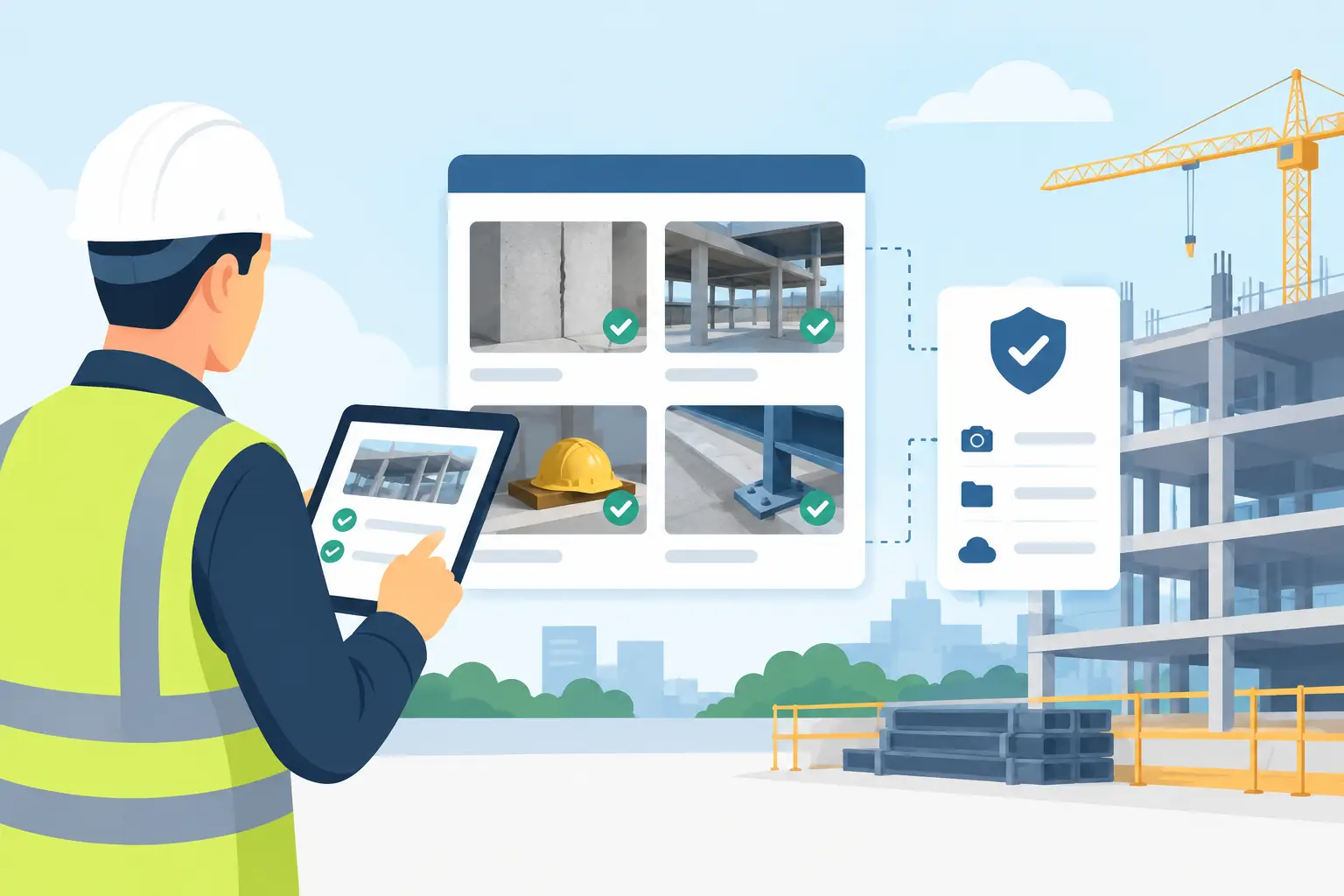
A site inspection is only as defensible as the evidence behind it. A checklist marked complete, a verbal confirmation, or photographs stored on a personal device may help the immediate team, but they do not create a reliable project record. Inspection evidence management establishes a controlled process for capturing, reviewing, approving, retrieving, and retaining the records that prove work was inspected and decisions were made.
For construction and infrastructure teams, this is not simply an administrative improvement. Evidence supports payment, handover, quality verification, dispute resolution, safety accountability, and regulatory compliance. When records are scattered across paper forms, email threads, messaging applications, and individual phones, project teams lose time reconstructing what occurred. More seriously, they may be unable to demonstrate that supervision requirements were met.
What inspection evidence management must control
Inspection evidence includes far more than a completed inspection form. It may include photographs, videos, marked-up drawings, test certificates, location data, nonconformance records, corrective-action evidence, approval comments, signatures, and correspondence connected to an inspection. Each item needs context before it becomes dependable evidence.
At a minimum, the system should connect evidence to the relevant project, contract package, location, work activity, inspection request, date and time, responsible parties, and document revision. A photograph of reinforcement work has limited value if the team cannot identify the exact area, the approved drawing revision, the inspection stage, and the person who accepted or rejected the work.
This is where an enterprise approach differs from merely digitizing a paper checklist. Digitization converts a form into a file. Controlled evidence management preserves the relationship between the form, supporting material, workflow status, and final record. That relationship is what allows a project team to retrieve a complete and credible inspection history months or years later.
Why paper-based evidence fails under pressure
Paper processes often appear workable when an inspection is routine and the team is stable. The weakness emerges when work accelerates, supervisors change, a nonconformance remains open, or an audit asks for records across multiple work fronts. Staff then spend hours locating files, checking dates, comparing copies, and asking whether an image or approval is the final version.
Paper also creates a gap between field activity and project reporting. A form may be completed at the work area, scanned later, and filed days afterward. During that interval, managers cannot see whether the inspection was accepted, rejected, deferred, or awaiting corrective action. A delayed record can lead to work proceeding without clear authorization or corrective work being overlooked.
A digital process does not remove every risk. Poorly configured workflows can still create incomplete records, and field users will bypass a system that is slow or difficult to use. The objective is therefore not to impose more administration. It is to make the required evidence easier to capture correctly at the point of inspection.
Building an inspection evidence management process
A practical implementation begins with the actual supervision workflow, not with a generic document repository. Project teams should map how inspection requests are raised, who performs each inspection, what evidence is required, who can approve work, and what happens when an item fails. This process should reflect the contract requirements, inspection and test plans, quality procedures, and client reporting obligations.
Define evidence by inspection type
Not every inspection requires the same record set. A concrete pour inspection may require approved method statements, reinforcement photographs, delivery tickets, test results, and release confirmation. A structural steel inspection may require weld records, material certificates, dimensional checks, and close-up images of relevant connections. A simple checklist applied to every activity creates unnecessary effort in some cases and insufficient control in others.
Templates should therefore be configured by work type and inspection stage. Required fields can guide inspectors to record the right location, drawing reference, observations, and outcome. Mandatory attachments should be used carefully. They are appropriate where visual or test evidence is essential, but excessive mandatory fields can slow site operations and encourage low-quality submissions.
Capture evidence where the work happens
Field-ready capture is central to timely records. Supervisors should be able to create or complete inspection records from a tablet or mobile device, attach photographs immediately, add annotations, and submit the record into the approval workflow. Where site connectivity is unreliable, offline capability and controlled synchronization should be assessed during system selection and pilot testing.
Image capture should retain its association with the inspection rather than placing all photos in an unstructured project folder. Clear file naming, automatic timestamps, location references where appropriate, and annotations help reviewers understand what each image proves. Photos should supplement the inspection finding, not replace a clear written description of the issue or acceptance decision.
Apply controlled workflow and approvals
Inspection evidence becomes reliable when its status is visible and its approvals are traceable. A structured workflow can route requests to the relevant inspector, notify responsible parties of rejected work, require corrective-action closure, and prevent unauthorized users from changing an approved record without a trace.
The approval design should match project governance. A small contractor may need a straightforward submit-review-close process. A major public works project may require separate roles for contractor quality staff, site supervision personnel, consultants, and client representatives. In both cases, the system should record who acted, when they acted, what decision was made, and any conditions attached to the approval.
Version control is equally important. If an inspection is revised after a rejection or additional evidence is submitted, the record should show the sequence of events. Overwriting the original submission may be convenient, but it can remove the history needed to demonstrate how an issue was identified and resolved.
Connecting evidence to documents and models
Inspection records are more useful when they are connected to the controlled documents that governed the work. This includes drawings, specifications, method statements, inspection and test plans, permits, and material approvals. Linking records to approved document revisions helps prevent a common site problem: evidence is collected against an outdated drawing or superseded instruction.
For projects using building information modeling, model integration can add further value. Inspectors can associate issues, observations, and evidence with a specific asset, zone, or model element. This improves spatial clarity, particularly on complex civil, rail, utility, and building projects. However, BIM integration should serve the inspection process rather than become a separate technical exercise. If field users cannot easily locate the right element, a structured location hierarchy may be more effective for some work packages.
A Digital Works Supervision System can bring these records together with enterprise document management capabilities, providing a controlled environment for site forms, correspondence, approvals, and long-term retention. InnoShare DWSS 2.0, for example, is designed to support digital works supervision workflows while maintaining the document control discipline required by construction-intensive projects.
Reporting that supports action, not just compliance
The value of managed evidence increases when project leaders can see trends without manually consolidating spreadsheets. Dashboards and reports should identify inspection volumes, approval turnaround times, overdue actions, rejected items, recurring nonconformances, and outstanding evidence requirements. These indicators allow managers to address a weak process before it affects the construction program.
Reporting requires disciplined data entry. Location codes, work categories, inspection outcomes, and responsible parties should use controlled values wherever possible. Free-text fields remain necessary for observations and technical comments, but they should not be the only source of project intelligence.
Teams should also distinguish between operational reporting and formal records. A dashboard can show that ten inspections remain open. The supporting records must still be retained with their attachments, audit history, and approvals. Both views are needed: one to manage today’s work and one to defend the project record later.
Implementation decisions that determine adoption
Technology alone will not correct inconsistent inspection practices. Successful deployment requires a clear records structure, agreed workflow ownership, user training, and practical support during the first stages of site use. Pilot the system on a representative work package before full rollout. This exposes issues with forms, approval routes, devices, connectivity, and user permissions while changes are still manageable.
Configuration should also balance project-specific needs with repeatability. Every major project has different contract requirements, but building every form and workflow from scratch increases maintenance and makes training harder. Reusable templates, controlled customization, and a defined governance process provide a better balance.
Retention and access rules need early attention. Inspection evidence may need to remain available well beyond project completion, particularly for assets with long operating lives. Define who owns the final record, where it will be retained, which users can retrieve it, and how the organization will preserve audit trails through handover and closeout.
The practical test is simple: when a stakeholder asks why work was accepted, rejected, or released, the project team should be able to produce the complete evidence trail without searching through boxes, personal devices, or disconnected systems. Designing for that moment creates stronger supervision every day before it arrives.
Comments are closed.