

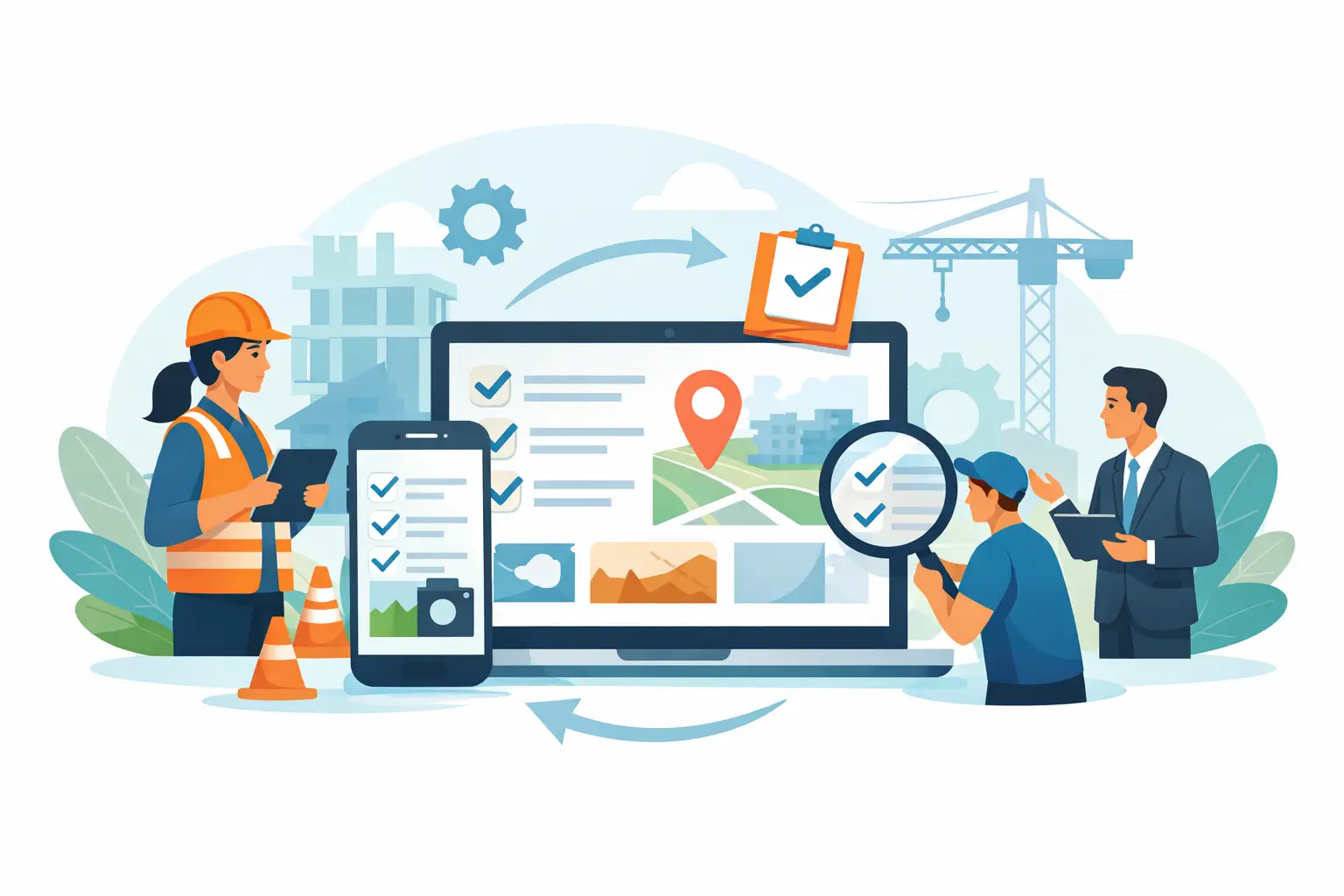
Paper inspection forms rarely fail all at once. The problem is usually slower and more expensive than that. A signed checklist sits in a vehicle, photos stay on a phone, a corrective action gets mentioned verbally, and by the time someone asks for proof, the record is incomplete. That is exactly where site inspection workflow software changes project control. It turns site supervision from a scattered set of manual tasks into a structured, traceable process that stands up to operational pressure and audit review.
For construction firms, civil contractors, consultants, and infrastructure project teams, this is not just a convenience issue. It affects compliance, response time, accountability, and the quality of project records handed over at completion. The right system does more than digitize a paper form. It defines who inspects, what must be checked, when approvals are required, how nonconformities are tracked, and where the official record is stored.
What site inspection workflow software actually does
At a practical level, site inspection workflow software manages the full inspection cycle from initiation to closeout. An inspector can create or receive an assigned inspection, complete a standardized form in the field, attach photos and supporting documents, and submit it for review. Supervisors or engineers can then verify findings, request clarification, approve outcomes, or trigger follow-up actions.
That sounds straightforward, but the real value is in the control framework behind it. Mandatory fields reduce incomplete submissions. Standardized templates improve consistency across teams and projects. Time stamps, user logs, and revision history create accountability. When linked to document control and records management, the inspection record becomes part of the project’s official information set rather than a loose file stored in someone’s inbox.
This matters most on large or compliance-sensitive projects, where works supervision is not an informal activity. It is part of contract administration, quality management, and regulatory reporting. In those environments, software must support process discipline, not just mobile convenience.
Why paper-based inspections break down
Most organizations do not keep paper because they prefer it. They keep it because inspections evolved around site realities, legacy procedures, and fragmented responsibilities. A supervisor needs a form that works in the field. A QA team needs traceability. A document controller needs complete records. A project manager needs visibility into open issues. On paper, each of those needs gets handled separately, which is why the process becomes vulnerable.
The first issue is inconsistency. Different teams may use slightly different forms, naming conventions, or filing methods. The second is delay. Records often move from site to office in batches, which means management sees problems after the fact. The third is weak auditability. If attachments are missing, signatures are unclear, or corrective actions are tracked outside the original inspection, the record becomes harder to defend.
There is also a practical trade-off that many teams underestimate. Paper can feel flexible in the field, but that flexibility often shifts the burden downstream. Office staff spend time chasing missing details, re-entering data, organizing scans, and answering status questions. The apparent simplicity on site creates administrative drag everywhere else.
The core capabilities that matter most
Not every platform is suitable for construction and infrastructure supervision. Generic field apps may capture observations, but they often fall short when projects require formal approval paths, structured document retention, and integration with enterprise records.
A workable platform should support configurable inspection templates, role-based workflows, approval routing, photo and file attachment, and status tracking for defects or follow-up actions. It should also maintain a clear audit trail and support controlled storage of records. For many organizations, mobile use is essential, but mobility alone is not enough. The software must also fit established governance requirements.
The strongest systems are built around operational reality. They allow teams to adapt forms to specific contract requirements, disciplines, or work packages without breaking standardization. They support review and escalation rules that reflect actual authority levels. They also reduce duplicate handling by connecting inspection records to a broader document and information management environment.
Site inspection workflow software and compliance control
Compliance is where the difference between a simple app and an enterprise-ready system becomes clear. If your project is subject to strict supervision procedures, contractual obligations, or public sector documentation standards, inspection records must be complete, retrievable, and defensible.
Site inspection workflow software supports this by enforcing structured data capture and preserving the sequence of events. Who performed the inspection, when it was submitted, who reviewed it, what evidence was attached, and how the issue was closed can all be recorded within one controlled workflow. That is far stronger than reconstructing a history from paper files, emails, messaging threads, and disconnected photo folders.
For organizations operating under Digital Works Supervision System requirements or similar compliance frameworks, software selection should be based on process fit, not feature volume. A platform with many generic functions may still create gaps if it cannot align with required supervision procedures or records retention expectations.
Implementation is where projects succeed or stall
Buying software is the easy part. Getting inspectors, engineers, document controllers, and managers to use it correctly is where the project either gains value or loses momentum. That is why implementation matters as much as product capability.
A successful rollout starts with process mapping. Existing inspection types, approval paths, document outputs, and reporting needs should be reviewed before configuration begins. If teams skip that step, they often reproduce old inefficiencies inside a new system. A digital form alone does not fix a weak workflow.
Training also needs to reflect different roles. Field users need speed and clarity. Approvers need confidence in review steps and exceptions. Administrative teams need to understand records structure, reporting, and system controls. In enterprise construction environments, change management is not a soft issue. It directly affects data quality and adoption.
This is where a specialist implementation partner adds value. Organizations that work with providers experienced in works supervision, construction documentation, and enterprise information management usually reach practical deployment faster because the system is configured around real project conditions rather than generic software assumptions.
When integration matters more than extra features
One common mistake is evaluating site inspection workflow software as a standalone tool. In practice, inspections connect to drawings, method statements, quality records, correspondence, handover documentation, and sometimes BIM-related information. If the inspection process sits outside that environment, users end up duplicating effort.
Integration with EDMS and related project systems improves control in several ways. It reduces manual filing, supports consistent document references, and helps teams retrieve complete records later. It also supports continuity from site activity through project closeout. For contractors and public works teams, that continuity can be just as important as day-to-day efficiency.
Innovative Associate Technology has positioned this area well through systems that connect digital works supervision, site inspection, and enterprise document management. That matters because many project teams do not need another disconnected field app. They need a controlled supervision environment that fits broader project records requirements.
How to judge whether a platform is right for your project
The best evaluation questions are operational. Can the software reflect your inspection hierarchy and approval process? Can it support formal records management, not just data capture? Can field teams use it efficiently without compromising quality? Can the system be customized without creating a maintenance burden? And can the vendor provide planning, configuration, training, and support through live project conditions?
It also helps to be realistic about scale. A small project with light documentation needs may accept a simpler setup. A major infrastructure program with multiple stakeholders, contractual controls, and long retention periods usually cannot. In those cases, reliability, traceability, and implementation support outweigh a polished interface or a long feature list.
The right choice is usually the one that reduces process risk while fitting how your teams actually work. That means balancing usability with governance, mobility with control, and speed with record quality.
Site inspections are where quality, compliance, and execution meet in real time. If the workflow around them is weak, the impact spreads across the project. If the workflow is structured, auditable, and properly implemented, teams gain more than efficiency. They gain confidence that the record will hold when it matters most.
Comments are closed.