

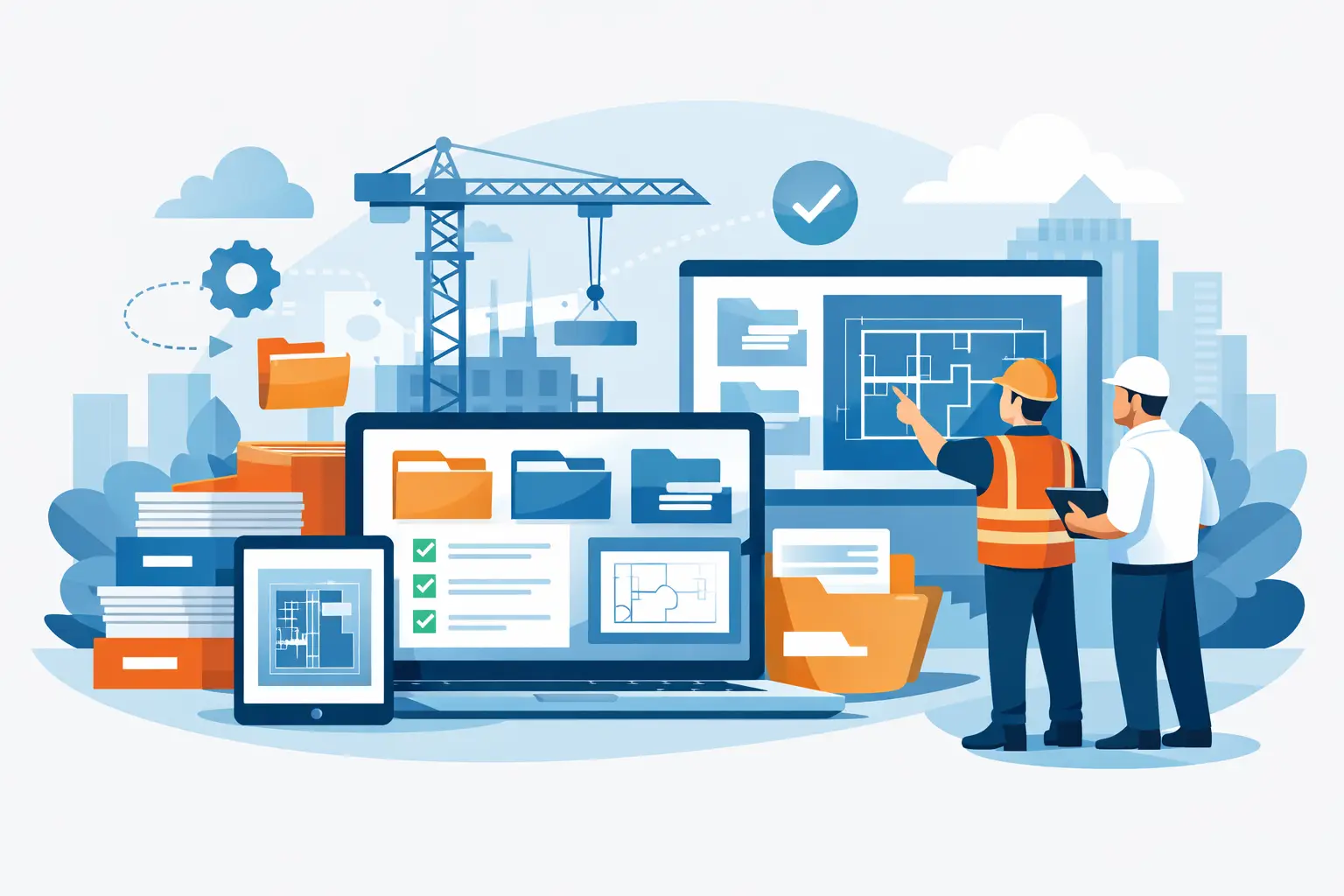
A drawing marked up on-site at 7:30 a.m. can affect procurement, inspection, payment, and compliance before lunch. When that change is still trapped in email threads, paper folders, or disconnected drives, the problem is not just inefficiency. It is loss of control. Construction document control software exists to prevent that gap between field activity and project record.
For contractors, consultants, and infrastructure project teams, document control is not an administrative side task. It sits inside supervision, quality checks, inspections, approvals, and final handover. The right system does more than store files. It creates an auditable structure for how records are captured, reviewed, distributed, and retained across the full project lifecycle.
What construction document control software should actually solve
Many platforms claim to centralize documents, but construction teams rarely struggle because files have no storage location. The real issue is that project records move through multiple parties, multiple revisions, and multiple approval points under time pressure. Site photos, inspection forms, method statements, RFIs, shop drawings, test reports, and supervision records all need to be current, traceable, and easy to retrieve.
That is why construction document control software must be built around process, not just folders. A useful system should support revision control, approval routing, access permissions, transmittals, version history, and field capture. If those functions are weak, teams still fall back on side channels such as email, spreadsheets, messaging apps, or paper signatures.
This is where many implementations fail. A generic document repository may look adequate during procurement, but it often creates friction once the project is live. Construction teams need document control that reflects how work is supervised, how compliance is demonstrated, and how records are defended during audits or claims.
Why paper-heavy control breaks down on active projects
Paper remains common on many jobs because it is familiar and easy to circulate in the moment. The trade-off is that paper does not scale well when projects become larger, more regulated, or more distributed. A signed inspection sheet in a site office cabinet may satisfy one immediate task, but it does little for enterprise visibility, trend analysis, or rapid retrieval months later.
Manual control also introduces timing risk. A superseded drawing can remain in circulation longer than anyone realizes. An approval can be delayed because the right reviewer never received the latest version. A compliance record can be technically complete but practically unusable because it cannot be found quickly enough.
These are not edge cases. They are common operational failures that affect schedule confidence, quality assurance, and stakeholder trust. The larger and more compliance-sensitive the project, the more costly these failures become.
The difference between generic EDMS tools and construction-focused control
Not every enterprise document management platform is suitable for site supervision and construction delivery. Generic systems are often strong at retention, indexing, and corporate records governance. Those are valuable functions, but field teams also need practical support for inspection workflows, site observations, approvals, and supervision records tied directly to project activity.
Construction document control software should bridge office governance and field execution. That means mobile or site-ready data capture, configurable workflows, clear audit trails, structured forms, and integration with broader document and records management practices. In some environments, it also means alignment with formal works supervision requirements and project-specific compliance obligations.
A strong deployment usually combines both layers. Teams need operational tools that support day-to-day supervision, and they need enterprise controls that support retention, traceability, and long-term record management. If either side is missing, the system becomes incomplete. It may work for the field but fail at governance, or satisfy governance while being ignored by site staff.
What to look for in construction document control software
The starting point is controlled document lifecycle management. Teams should be able to create, review, issue, revise, archive, and retrieve records without ambiguity. Version control must be visible and reliable. Permissions should reflect actual project roles, not broad shared access that creates confusion over who can view, edit, or approve.
Workflow configuration matters just as much. Construction records do not all follow the same path. An inspection checklist, a nonconformance record, and a drawing submission may each require different review steps, turnaround times, and responsible parties. Software should be flexible enough to support these differences without forcing users into a rigid process that does not fit the job.
Auditability is another non-negotiable feature. Teams should be able to show who submitted a document, who reviewed it, what changed, when it changed, and which version was in effect at a given time. This is essential not only for compliance but also for dispute avoidance and internal accountability.
Field usability deserves close scrutiny. If site staff need excessive clicks, poor connectivity workarounds, or duplicate data entry, adoption will suffer. Good systems reduce administrative burden at the point of work. They make capture faster, not slower.
Finally, implementation support should be treated as part of the product decision. Even capable software underperforms when classification rules, metadata, approval paths, and user roles are not configured properly. For construction-intensive organizations, deployment planning, customization, training, and ongoing maintenance are often what determine whether the system delivers measurable control.
Where compliance and supervision requirements change the software decision
In regulated construction environments, documentation is not just evidence of activity. It is evidence of compliance. That changes what buyers should prioritize. A platform may offer modern dashboards and clean file storage, but if it cannot support required supervision workflows, structured approvals, and auditable records, it creates exposure rather than reducing it.
This is especially relevant for public works, infrastructure contracts, and projects where formal site supervision processes must be demonstrated consistently. In these cases, software has to support disciplined execution. That includes standard forms, controlled revisions, approval accountability, and complete records that stand up to external review.
It also means integration matters. Document control should not sit in isolation from BIM-related information, enterprise repositories, or records management environments. When systems are disconnected, users end up re-entering data, reconciling inconsistent records, and maintaining parallel logs. That is inefficient, but more importantly, it weakens trust in the record set.
Implementation is where success is decided
Software selection gets attention, but implementation is where projects either gain control or add another underused platform. Construction document control software should be deployed with a clear understanding of document types, approval chains, reporting needs, retention obligations, and field conditions.
That work starts before go-live. Teams need to map current processes honestly, including where delays, duplication, and informal workarounds occur. If those realities are ignored, the new system simply digitizes old problems.
Training should be role-based rather than generic. Project managers, document controllers, site supervisors, QA/QC staff, and executives each need different views and functions. Adoption improves when the system reflects the user’s responsibility and reduces real workload.
There is also a practical balance to strike between standardization and customization. Too little structure leads to inconsistent use. Too much customization can create long-term maintenance issues and make future scaling difficult. The right answer depends on project complexity, regulatory demands, and the maturity of the organization’s internal controls.
Providers with construction domain knowledge are often better positioned here because they understand the difference between managing files and managing project records under supervision and compliance pressure. That is why implementation services such as configuration, site training, consultation, and support are not extras. They are part of the operating model.
A better standard for project record control
The best result is not a prettier document library. It is a working environment where current information is easier to trust, supervision records are easier to complete, approvals are easier to trace, and audits are easier to answer. That standard requires software designed for the realities of construction delivery, backed by implementation discipline.
For organizations managing infrastructure and construction-intensive projects, the question is no longer whether digital control is necessary. The real question is whether the system in place reflects how projects are actually executed. A specialist approach, such as the one delivered by Innovative Associate Technology, is valuable because it aligns software capability with supervision practice, compliance needs, and long-term record integrity.
The most useful next step is not to ask which platform has the longest feature list. It is to ask where your current document flow loses control, and whether your software is fixing that problem at the source.
Comments are closed.