

A revised drawing issued without clear distribution can lead a site team to build from superseded information. An inspection record that cannot be retrieved may leave a contractor unable to demonstrate that a required hold point was completed. These are different failures, which is why records management vs document control is more than a terminology question for construction and infrastructure projects.
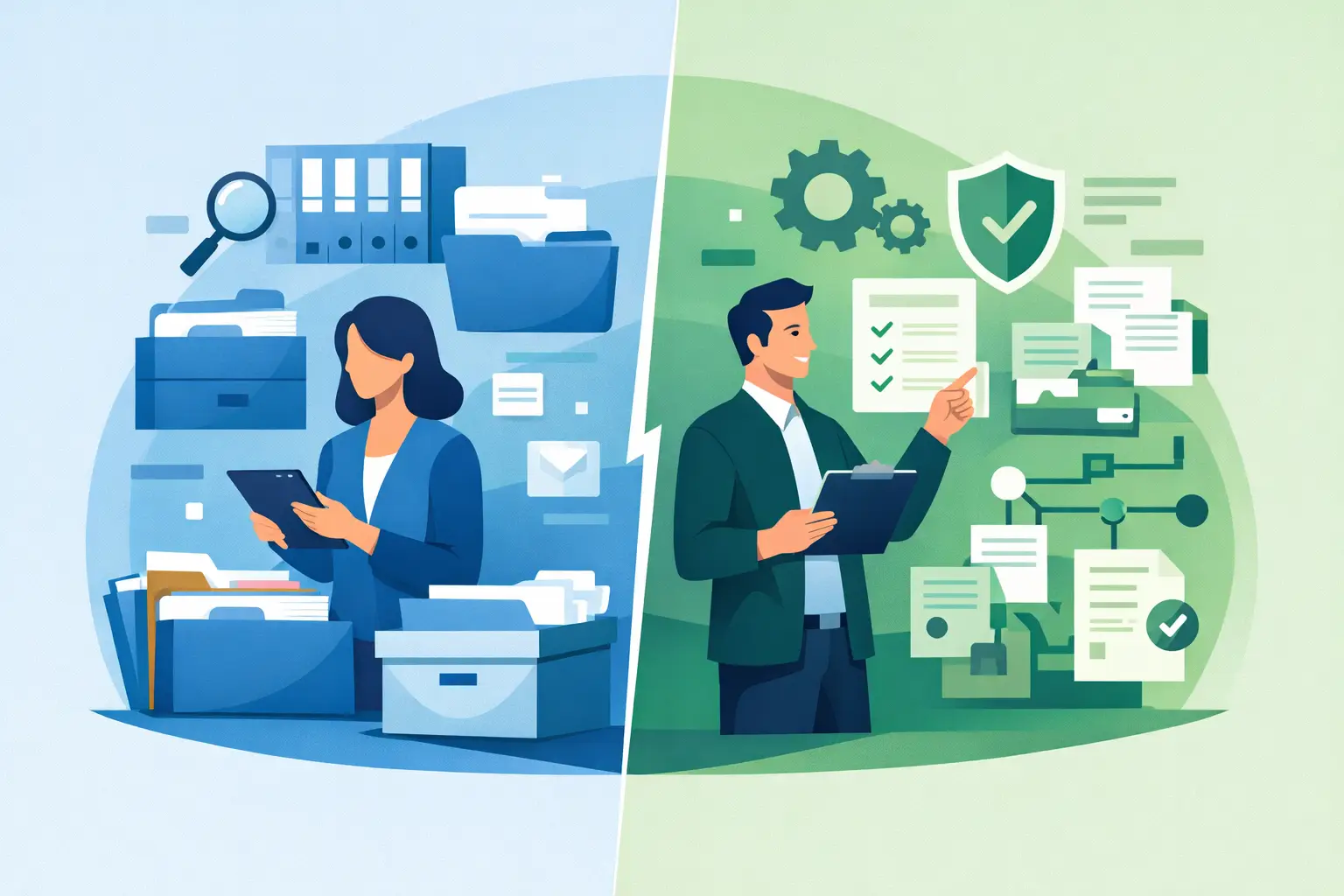
Document control governs information while it is active, changing, reviewed, and issued for use. Records management governs information once it must be retained as reliable evidence of what occurred, what was approved, and what obligations were met. Both disciplines must operate together, but they solve different operational and compliance risks.
Records Management vs Document Control: The Core Difference
Document control is concerned with the current, authorized version of a document. Its purpose is to ensure that drawings, specifications, method statements, inspection and test plans, requests for information, technical submissions, and correspondence are prepared, reviewed, approved, distributed, and revised under defined controls.
A document controller needs to answer practical site questions quickly: Which revision is approved for construction? Who has received it? Is the review overdue? Has the consultant returned comments? Is a superseded file clearly withdrawn from use? The focus is status, revision, workflow, distribution, and access.
Records management begins when information becomes evidence that must be protected and retained. The focus shifts to authenticity, completeness, classification, retention, retrieval, security, and defensible disposal. A record may be a signed inspection form, a daily site diary, an approval history, a test certificate, a final as-built drawing, a meeting minute, or an audit trail showing who approved a submission and when.
The distinction is simple, but the handoff is not always fixed. A drawing remains under document control through multiple revisions. When the final approved drawing is retained as part of the project closeout file, it also becomes a record. In many projects, the same information object has both a document-control role and a records-management role at different points in its lifecycle.
Why the Difference Matters on Site
Construction teams work with a high volume of changing information. Site staff need fast access to the right approved document, often from mobile devices and sometimes in constrained field conditions. At the same time, project owners, consultants, regulators, and internal quality teams may require evidence years after the work is complete.
Treating every file as a record from the moment it is created can slow active project work. It may impose excessive metadata requirements, restrictive access, and unnecessary retention controls on drafts and working files. Treating all information only as documents creates the opposite problem: critical evidence can be overwritten, lost in personal folders, or retained without a clear classification and retention rule.
The operational goal is not to create more administration. It is to establish the right control at the right stage. Active information must be accurate and available for execution. Completed evidence must be preserved in a form that can be trusted and retrieved.
Document Control Supports Safe, Current Execution
A controlled document process normally establishes a unique document number, title, discipline, revision, status, originator, reviewer, approver, and distribution list. It should also show whether the document is for review, information, tender, construction, or record purposes.
For example, if a structural detail changes after a design review, the system should retain the revision history, route the updated file to the required parties, and prevent site users from mistaking the previous revision for the current approved version. This is a direct execution control. It reduces rework, conflicting instructions, and avoidable disputes.
Document control is especially valuable where review cycles involve contractors, consultants, client representatives, subcontractors, and government stakeholders. A structured workflow establishes accountability without relying on email chains, untracked attachments, or verbal confirmation.
Records Management Preserves Evidence and Accountability
Once an inspection is completed and accepted, the resulting form is no longer merely a working document. It is evidence that a particular activity was inspected, by identified personnel, at a stated time, against specified criteria. Its integrity matters.
A records-management process should protect that evidence from unauthorized alteration, retain the relevant attachments and approval trail, and apply retention requirements appropriate to the contract, project, and governing authority. It should also make records searchable by attributes that reflect how project teams and auditors actually work, such as contract number, location, work package, discipline, asset, date, contractor, and inspection type.
The required retention period depends on contractual obligations, legal requirements, warranty exposure, asset handover needs, and organizational policy. There is no single schedule that fits every project. However, a defined retention schedule is preferable to keeping everything indefinitely. Indefinite retention increases storage, discovery, privacy, and retrieval burdens while making important evidence harder to find.
The Handoff From Controlled Document to Project Record
The most effective approach defines lifecycle rules before mobilization rather than trying to organize records at project closeout. Teams should identify which deliverables require formal version control, which transactions create official records, who owns each classification decision, and how records will be transferred to the client or asset operator.
A practical lifecycle often follows this sequence:
- A document is created or received and assigned a controlled identity.
- It moves through review, comment, approval, rejection, or revision workflows.
- The approved version is issued to the relevant project participants for action.
- A completed transaction, approval, inspection, or final deliverable is declared as a record and retained with its associated evidence.
- At closeout, records are validated, indexed, transferred, and retained or disposed of according to approved requirements.
The details vary by contract. A contractor working under a strict public works specification may require formal transmittals, defined response periods, and mandatory record formats. A smaller private project may use a lighter workflow. The principle remains the same: controls should reflect project risk, contractual requirements, and the consequences of using incorrect or unverifiable information.
What a Construction Information System Should Control
A folder structure alone is not a document-control or records-management system. Folders can organize files, but they do not reliably enforce revision status, approvals, audit trails, permissions, retention triggers, or searchable metadata.
For construction-intensive organizations, the system should connect document control with the field processes that generate evidence. Inspection requests, site observations, nonconformance reports, test results, photographic records, daily reports, and approval forms should be captured within defined workflows rather than reconstructed later from disconnected sources.
This is where implementation discipline matters as much as software capability. A platform can provide versioning and workflow functions, but project teams still need agreed document numbering, status codes, review matrices, naming conventions, retention categories, permissions, and training. Without these foundations, users may bypass the process under schedule pressure.
InnoShare DWSS 2.0 can support this type of controlled environment by bringing digital works supervision activities, inspection workflows, and project documentation into a structured system. The value comes from configuring the system around the actual contract workflow, site roles, approval authorities, and record requirements, then supporting users through deployment and ongoing operation.
Common Gaps That Create Audit Exposure
One common gap is relying on email as the approval system. Email may show that a message was sent, but it rarely provides a complete, consistent view of document status, final revision, response deadlines, and formal acceptance. Important attachments can also become separated from the decision they support.
Another gap is allowing field records to remain on individual devices or in informal messaging channels. Photos, inspection notes, and site observations may be useful at the time, but they become weak evidence if their source, date, location, and approval status cannot be established later.
A third gap appears at project closeout. Teams often discover that final records are incomplete, duplicated, inconsistently named, or stored across several systems. Closeout then becomes a costly manual exercise. Defining handover requirements early allows teams to capture the necessary metadata as work is performed, not months afterward.
Building a Practical Governance Model
Clear ownership is essential. Document control staff should manage the active-document process, but they should not be expected to determine retention requirements alone. Project management, QA/QC, engineering, legal or compliance functions, and client representatives may all have a role in defining what constitutes an official record.
Governance should be documented in a project information management plan that sets out workflows, responsibilities, document types, approval authorities, access controls, retention rules, and closeout deliverables. It should be reviewed when the scope, contract requirements, or delivery model changes.
Training must also be role-specific. A site inspector needs a simple method to submit and approve field evidence. An engineer needs confidence that the current technical document is visible. A document controller needs tools to manage revisions and transmittals. A project manager needs reporting that shows pending actions, overdue reviews, and record completeness. One generic training session rarely addresses all of these needs.
The strongest projects do not force a choice between document control and records management. They connect them. Current information reaches the people doing the work; completed evidence is retained with the context needed to defend it. That connection gives project teams a more dependable basis for daily decisions, compliance reviews, and future asset stewardship.
Comments are closed.