

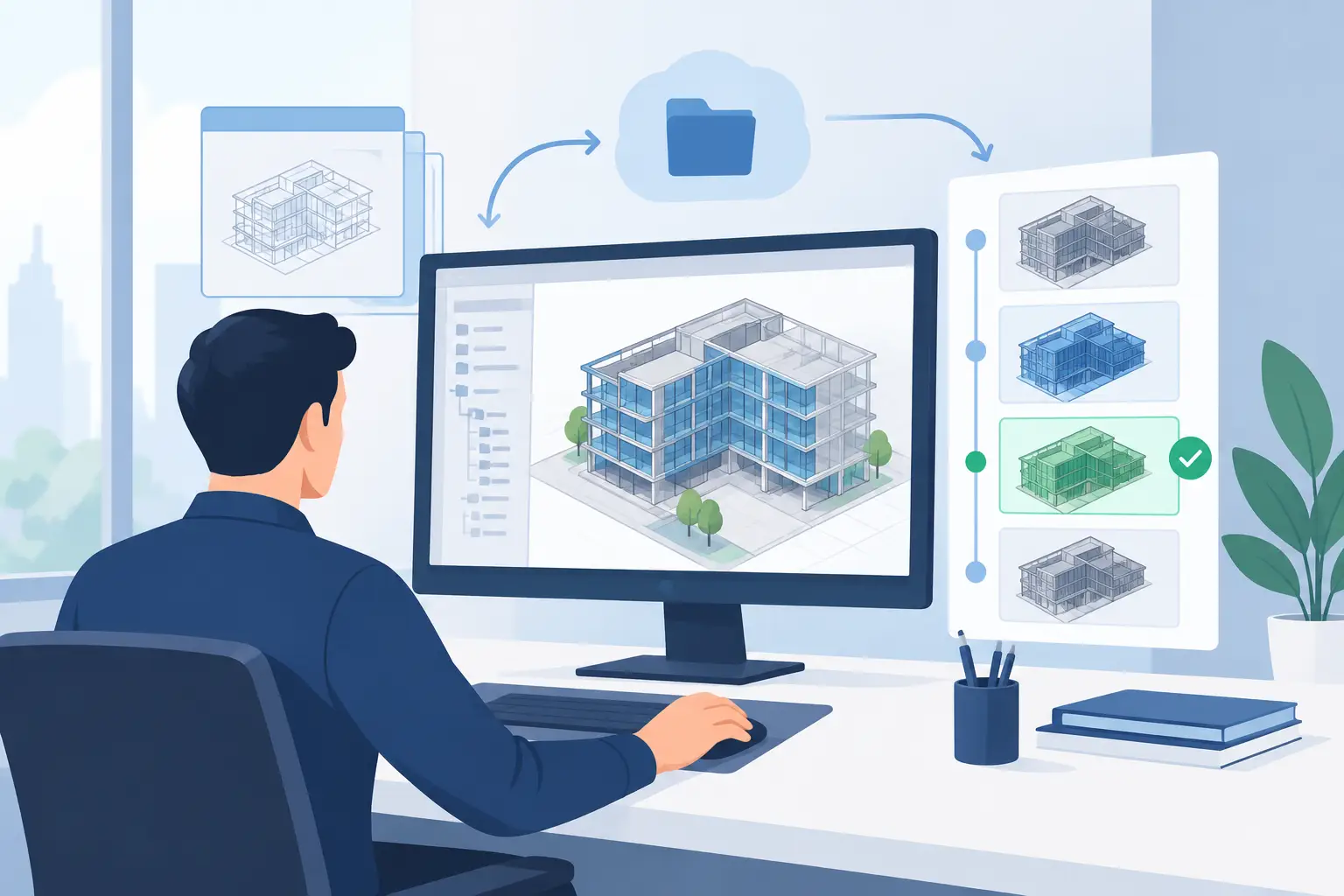
A revised BIM model can change far more than geometry. It can affect an approved shop drawing, a site inspection record, a method statement, a construction sequence, or a payment-related record. Knowing how to manage BIM revisions is therefore not a matter of saving files with better names. It is a controlled project process that connects technical change, review responsibility, document status, and site execution.
On large construction and infrastructure projects, the risk is rarely that a team member cannot create a new model version. The risk is that different parties act on different information. A contractor may build from a superseded drawing, a consultant may review an incomplete update, or a supervisor may close an inspection without evidence that the relevant model change was assessed. The resulting rework, disputes, and audit gaps are expensive because they are discovered late.
Why BIM revisions need formal control
BIM coordination is often discussed as a design activity, but revisions continue throughout procurement, construction, commissioning, and handover. At each stage, the project needs to answer four direct questions: what changed, why did it change, who accepted it, and which records were affected?
A model revision should never be treated as an isolated upload. If a revised structural opening changes the installation sequence, the project team may need to update drawings, requests for information, inspection and test plans, site instructions, photographs, and approval records. The exact impact depends on the scope of the change, but the review must be deliberate.
This is particularly relevant on compliance-sensitive public works and capital projects. A document control process must demonstrate not only that information was available, but that the correct revision was issued, reviewed, and used under an authorized workflow. Email attachments and shared folders can support communication, but they do not provide sufficient control on their own.
Establish one source of truth for BIM information
The first control is simple in principle: every approved project participant must know where the current model and related controlled documents reside. In practice, this requires a common data environment or enterprise document management system with defined permissions, metadata, and status rules.
The system should distinguish clearly between work in progress, information shared for coordination, information submitted for review, approved information for construction, and superseded records. A revision is not automatically suitable for site use because it exists in the system. Its status must state whether it is under review, approved with comments, rejected, or authorized for construction.
Avoid creating parallel locations for the same information. If the design team issues models through one platform, the construction team maintains drawings in another, and site supervision records sit in disconnected folders, reconciliation becomes a manual task. That may be manageable on a small package. On a multi-discipline infrastructure project, it creates a persistent risk of inconsistent records.
A controlled platform should also preserve prior revisions rather than overwrite them. Historical versions are necessary for traceability, claims review, quality investigations, and handover. The goal is not to make old information disappear. It is to make its superseded status unmistakable.
Define revision rules before design changes accelerate
Teams should agree on revision rules during mobilization, before the volume of changes increases. These rules need to cover model naming, document numbering, revision identifiers, submission packages, required metadata, and approval routes. Consistency matters more than choosing a complicated convention.
Each revision package should identify the originating discipline, the reason for the change, the affected zones or assets, and the records requiring review. A short, precise change description is more useful than a generic label such as “updated model.” For example, “Level 3 mechanical riser rerouted to resolve structural clash” gives reviewers a starting point for assessing downstream effects.
Revision identifiers must align across connected information where practical. A drawing issued from a model, a coordination report, and a related site instruction do not need identical filenames, but their relationship should be traceable through document numbers, transmittals, or system links. This prevents reviewers from spending time determining whether they are looking at the correct package.
Assign ownership for every review decision
Clear ownership is what turns a BIM revision process into a dependable control process. The model author is responsible for preparing the revision and identifying the change. The discipline lead is responsible for technical checking. The BIM coordinator assesses coordination implications. The consultant, client, or authorized reviewer provides the required approval. The contractor then confirms that approved changes have been incorporated into construction planning and site records.
These roles may overlap on a smaller project, but the responsibilities should still be explicit. A common failure is assuming that a coordination meeting constitutes approval. Meetings are valuable for resolving issues, yet a discussion does not replace a recorded review decision with accountable approval status.
Set target response times according to change criticality. A minor labeling correction may follow a routine review cycle. A change affecting temporary works, safety, interfaces, statutory requirements, or active construction needs immediate escalation. The process should allow speed without bypassing authorization.
How to manage BIM revisions through a controlled workflow
A practical workflow begins when a change is identified, not when the revised model is published. The originator should log the change request or issue, assign a reference number, describe the cause, and identify affected disciplines and work areas. This creates a record before technical solutions begin to circulate.
The author then prepares the revision in the controlled authoring environment and completes internal quality checks. Before submission, the revision should be compared against the prior approved version. Model comparison tools can identify object-level additions, deletions, and modifications, but a human review remains necessary to interpret construction impact.
After coordination review, the system should route the package to the appropriate approvers. Review comments must be attached to the controlled record rather than scattered through email. When comments are resolved, the final decision should be recorded as an approval, conditional approval, rejection, or request for resubmission.
Once approved for construction, the revised information must be formally issued to the people who need it. This includes site engineers, supervisors, subcontractors, quality teams, and any stakeholder whose inspection or work sequence is affected. Receipt alone is not enough for high-risk changes. Teams may require acknowledgment and confirmation that obsolete copies have been withdrawn from active use.
Connect model changes to field supervision records
The strongest BIM revision process reaches the site. A model update should be linked to the records used to verify work, including inspection requests, inspection and test plans, nonconformance reports, site instructions, photographs, and daily supervision records.
Consider a revised rebar arrangement. The project should be able to show which approved model and drawing revision governed the work, which inspection was carried out, who accepted the inspection, and what photographic or test evidence supports the record. If a later query arises, this chain provides a defensible account of the decision and execution.
This is where a digital works supervision system and an enterprise document management system provide practical value. Rather than asking field teams to search through multiple repositories, the workflow can present the relevant approved records within the inspection or approval process. InnoShare DWSS 2.0, for example, is designed to support structured digital supervision workflows while retaining auditable documentation across project activities.
Mobile use deserves careful planning. Field users need access to current approved information, but unrestricted offline copies can create version-control issues. Define which documents are available offline, how often devices synchronize, and how the system handles records created while connectivity is unavailable.
Use dashboards to identify revision risk early
Revision control should not depend on someone manually chasing every overdue review. Project dashboards can show submissions awaiting approval, rejected packages, overdue responses, recently superseded construction documents, and open issues linked to model changes.
The most useful metrics are operational. Track approval turnaround time, the number of revisions issued after construction release, unresolved coordination issues by zone, and inspections affected by revised information. A high revision count is not automatically a problem. It may reflect active design development. Repeated late revisions in the same work area, however, may indicate weak coordination or incomplete design inputs.
Build the process around people, not only software
Technology enforces discipline only when the project team understands the process. Training should cover how to submit revisions, interpret statuses, respond to comments, retrieve approved information, and create linked site records. It should also explain why informal workarounds create compliance exposure.
Configuration should reflect the project’s contractual requirements, approval matrix, document coding, and supervision practices. A generic workflow may be adequate for low-risk internal coordination, while government or infrastructure projects often require more detailed authorization, record retention, and audit controls. The right level of control depends on project risk, contract obligations, and the maturity of participating organizations.
A well-managed BIM revision process gives teams confidence to act. When the approved model, supporting documents, and field evidence are connected in one accountable workflow, change becomes easier to verify, not harder to control.
Comments are closed.