

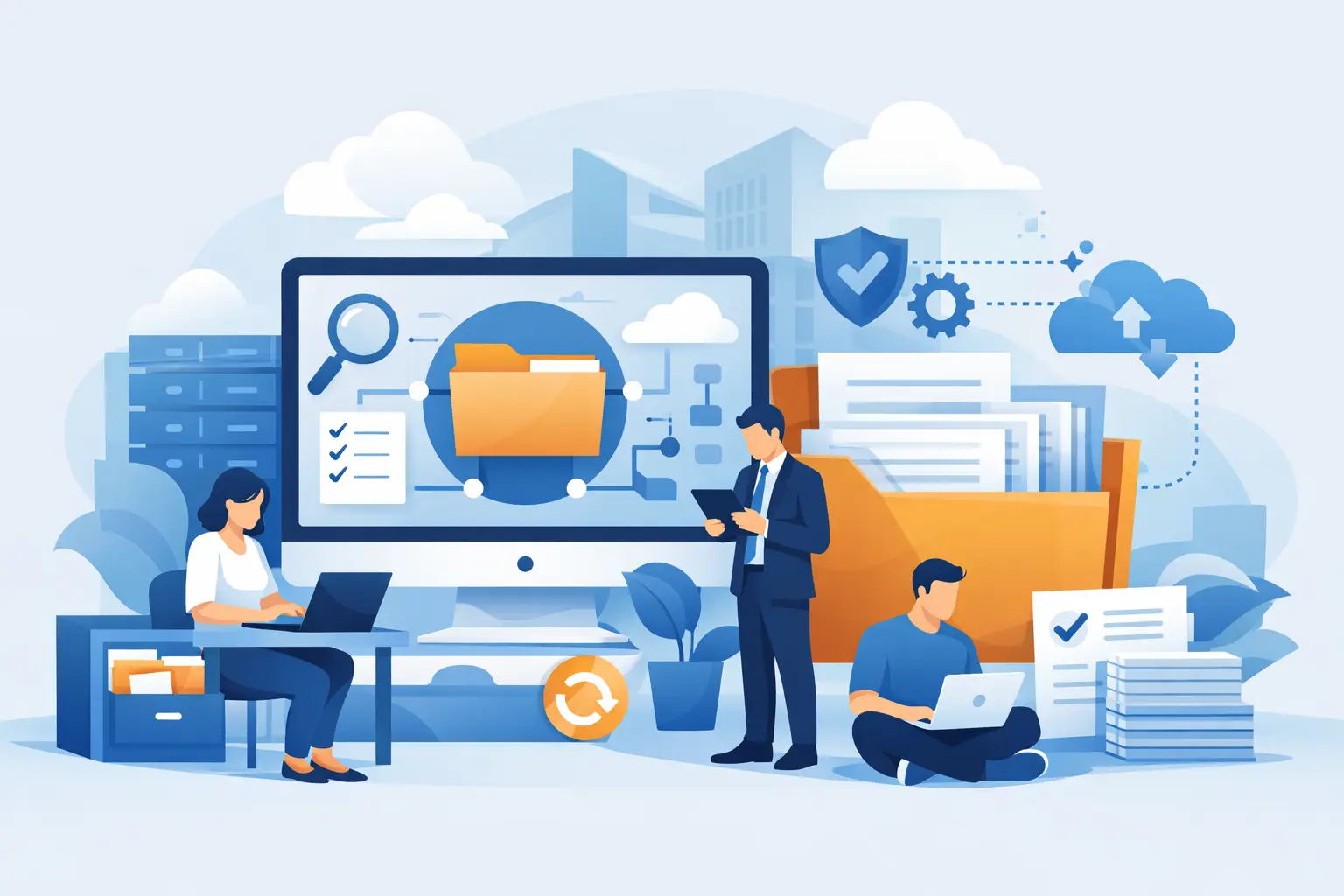
A missed drawing revision on a live project rarely looks like a document problem at first. It shows up as rework, an inspection delay, a dispute over approval status, or a compliance gap discovered too late. That is where an enterprise document management system EDMS becomes a project control issue, not just an IT decision.
For construction firms, infrastructure teams, consultants, and government contractors, document volume is only part of the challenge. The harder problem is keeping technical records accurate, current, traceable, and available to the right people at the right stage of work. When supervision records, inspection forms, RFIs, method statements, drawings, correspondence, and handover files are spread across email inboxes, shared drives, paper folders, and site offices, control breaks down quickly. A proper EDMS is meant to stop that from happening.
What an enterprise document management system EDMS should actually do
In many organizations, the term EDMS gets used loosely. A file repository, cloud drive, or scanned archive is sometimes labeled as document management, even when it cannot enforce review workflows, maintain revision history, or support audit requirements. For capital works and compliance-sensitive projects, that is not enough.
An enterprise document management system EDMS should provide structured control over the full document lifecycle. That includes document creation, classification, review, approval, issue, supersession, retrieval, retention, and final archiving. More importantly, it should do this in a way that reflects how project teams really work across design offices, site supervision teams, contractors, consultants, and client stakeholders.
In practice, that means controlled metadata, permission-based access, revision tracking, transmittal management, workflow routing, searchability, and a defensible audit trail. In a construction environment, it also means supporting field-generated records, photographic evidence, inspection reports, markup workflows, and integration with related project systems where needed.
Why construction and infrastructure projects need more than generic file storage
Generic platforms can store files well enough. The issue is that large construction projects are governed by process, contractual accountability, and regulatory obligations. A drawing is not simply a file. It may be tied to an approved submission, a construction sequence, a site instruction, a quality inspection, and a formal record of who reviewed it and when.
That is why project teams often outgrow general-purpose storage tools. A shared folder does not reliably tell site staff which revision is current. Email does not create disciplined approval workflows. Paper forms may capture signatures, but they create delays and make retrieval difficult during audits or claims review.
A well-configured EDMS gives structure to this complexity. It reduces the risk of uncontrolled copies, supports standard naming and coding conventions, and creates one governed environment for technical and administrative records. For teams working under public works requirements or strict internal QA procedures, that structure is not optional. It is part of delivery discipline.
Key capabilities that matter in an enterprise document management system EDMS
The right feature set depends on project type, contractual framework, and internal governance, but several capabilities are consistently important.
Revision control is fundamental. Teams need confidence that superseded documents are clearly identified, current versions are easy to locate, and historical records remain available for reference. Without that, field errors become far more likely.
Workflow automation is equally important. Review and approval cycles should not depend on informal reminders or manual forwarding. An EDMS should route documents based on defined business rules, capture actions taken, and record timestamps and decision points. This is especially useful for submissions, inspection records, nonconformance workflows, and controlled correspondence.
Auditability is another core requirement. Construction and infrastructure projects generate scrutiny from clients, consultants, internal quality teams, and in many cases regulatory bodies. The system should show who uploaded, reviewed, approved, revised, or issued a document. If a dispute arises, that record matters.
Field usability also deserves more attention than it often gets. A document platform may perform well at head office and still fail on site if forms are cumbersome, mobile access is poor, or image capture is unreliable. For supervision-heavy environments, the best systems support practical site use, not just back-office administration.
Implementation matters as much as software selection
Many EDMS projects underperform because buyers focus too heavily on software features and not enough on implementation design. In construction, the system has to reflect actual workflows, document types, approval authority, retention needs, and project reporting requirements. If those are not mapped properly, users work around the platform instead of through it.
A sound implementation starts with document control policy and operational reality. What documents need formal control? Which teams create them? Who reviews and approves them? What metadata is mandatory? What records must be retained for handover, claims defense, or statutory compliance? These questions shape the system structure.
Training is another deciding factor. Document controllers may adapt quickly, but project engineers, inspectors, and subcontractor-facing users need a system that fits their tasks with minimal friction. Effective rollout usually includes role-based training, site-level support, and clear operating procedures. That service element is often where implementation partners prove their value.
Customization also has to be handled carefully. Too little configuration and the platform feels generic. Too much customization and long-term maintenance becomes difficult. The right balance is to tailor the system to core operational and compliance requirements without creating unnecessary complexity.
Common trade-offs buyers should assess
There is no single best EDMS for every organization. The right choice depends on document volume, project complexity, regulatory exposure, and how standardized internal processes already are.
A highly configurable enterprise platform can support complex governance, but it may require stronger internal administration and longer deployment planning. A lighter system may be faster to adopt, but it can fall short when audit depth, workflow control, or integration demands increase.
Cloud deployment may improve accessibility across multiple project locations, but some clients and contractors still have strict hosting or data management requirements. Mobile capability is valuable for site teams, but offline performance and device management should be assessed realistically. Integration with BIM, ERP, project controls, or quality systems may be a major advantage, but only if the integration supports real use cases rather than adding technical overhead.
The practical question is not whether a platform has the longest feature list. It is whether it can support controlled execution across headquarters, project offices, and active construction sites without creating new bottlenecks.
How EDMS supports compliance, supervision, and project records
For project-based organizations, document management is closely tied to compliance performance. Inspection records, supervision checklists, material submissions, method statements, site photos, and approval records all contribute to the evidence base of project delivery. If those records are incomplete, inconsistent, or hard to retrieve, the risk extends beyond administration.
An EDMS helps create consistency in how these records are captured and maintained. Standard templates, controlled workflows, and centralized storage reduce variability between teams and projects. That matters when organizations need to demonstrate adherence to internal procedures, contract requirements, or public-sector supervision standards.
It also improves handover readiness. Too many teams treat final record compilation as a closing-stage exercise, only to discover that files are missing, approval paths are unclear, or naming conventions were never enforced. When documents are governed properly from the start, handover becomes a managed process instead of a recovery exercise.
For firms operating in construction-intensive environments, specialized providers such as Innovative Associate Technology bring an advantage when the platform must align with real supervision workflows, digital works supervision requirements, and the daily realities of site documentation.
What to look for before making a decision
A serious EDMS evaluation should include process review, not just software demonstrations. Buyers should test how the system handles an actual drawing revision, a site inspection record, a transmittal, a nonconformance workflow, and a handover retrieval request. Those scenarios reveal far more than a generic product tour.
It is also worth assessing the vendor’s implementation capability. Can they configure metadata and workflows around your document control structure? Can they support migration from paper and shared drives? Can they train site teams, not just administrators? Can they maintain the system after go-live and adapt it as project requirements change? In this market, dependable support is part of the solution.
An enterprise document management system EDMS should reduce uncertainty, not add another layer of administration. When it is selected and implemented properly, it strengthens control over records, approvals, revisions, and field documentation across the full project lifecycle. For organizations that build under scrutiny, that control is not a convenience. It is part of delivering the job properly the first time.
Comments are closed.